Full Text.
Three archetypal images
for complex psychology
Saturn, Mercury and Matangi
.
Archetypes — ancient, primordial patterns — can be said to underlie most, if not all, of our recurring life situations. The underworld journey, for instance, is an archetypal image at the core of encounters with serious illness or phases of intense psychotherapy. Working with our complexes, too, might be understood as involving a range of archetypal situations: the return of the repressed, the encounter with shadow, and so on.
In addition to these situational archetypes, are the archetypal personages which appear as the characters of folklore and myth — the sky god, the huntress, the trickster, and so on. Such figures recur across many world cultures, each ‘spiced’ a little differently, but all representing a slice of the same archetypal apple, if you will.
— Vine Deloria, Jr.footnote 1
Recognizing that he had devised a framework that could speak to different human traditions, Jung felt perfectly at home borrowing symbols and techniques from other cultures. This openness was possible because of the manner in which Jung conceived the psyche and his belief that all human psychological structures were basically the same.
Here, I hope to invite and invoke three such mythical personages, each of them with a unique connection to complex psychology. These iconic characters can become our teachers if we let them, instructing us through their images and powers, their tendencies and forms. Let’s begin with Saturn.
Saturn / Shani .
Today, the Roman deity Saturn is largely present as an astrological archetype: he is known through his
relationship to the planet Saturn and the effects Saturn is believed to have over the lifespan. That said,
one does not need to practice astrology to find value in astrological archetypes. Astrology, like the
collective unconscious
with which psychology is concerned,
writes C.G. Jung, consists of symbolic
configurations: the ‘planets’ are … symbols
of the powers of the unconscious.
footnote 2
Planetary Saturn
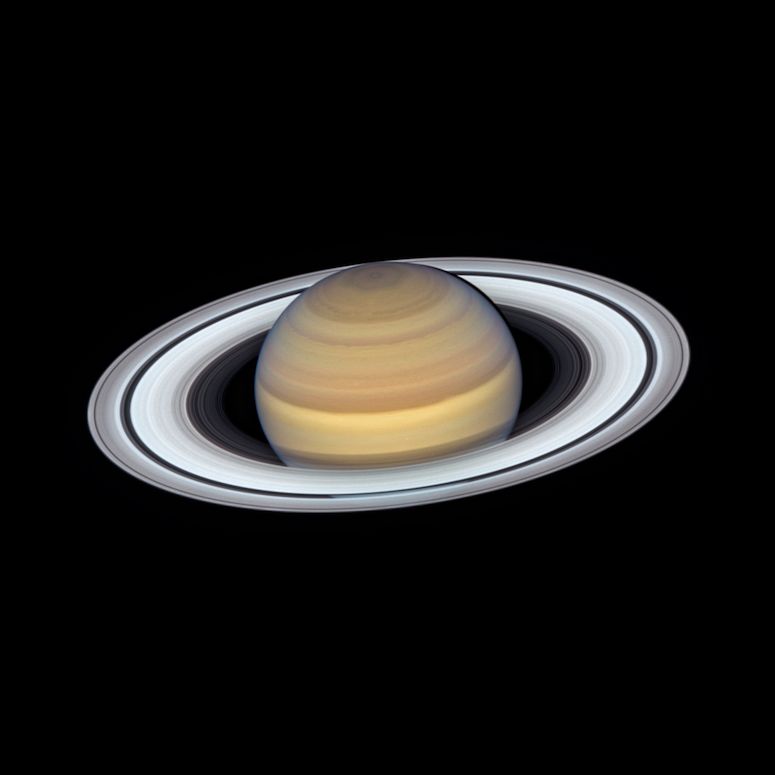
Image source: NASA
In this way, the figure of Saturn might be said to embody a structure or function of psyche. Here, I consider that Saturn is linked to the foundational structure known as the personal complex.
I am not the first to note this relationship. Shargel writes of a special relationship between the
archetype of Saturn and the concept of the psychological complex
footnote 3 and goes on to observe that
complexes are Saturnian in their judgmental, discouraging, shame inducing, frustrating and difficult
qualities, as well as their manifest, concrete, embodied expression, their resistance to change,
their connection with trauma, and their association with negativity.
footnote 4 While I propose a more
optimistic outlook on our complexes, my argument is essentially the same;
complexes display a number of Saturnian qualities. They exhibit a certain frozenness in time and insist
on certain ‘traditions’ of psyche, often holding on to traumatic and faulty learning long after the
original threat has passed. Saturn is understood to be slow moving, and exemplified in situations of
stuckness. In fact, few words better describe the conundrum of wounded complexes; they are stuck.
Not only can they not move on, but through projection and a certain sort of psychological magnetism,
they recreate their traumas in the inner and outer worlds, so that the ego-complex —
the person we understand as ‘I’ — feels stuck, too.
Rossi and LeGrice observe a related connection between Saturn and the shadow, that part of psyche where complexes reside.
Quoting astrologer Liz Greene, they note: The position of Saturn on the birth chart suggests a sphere
of the individual’s life in which he has somehow become stunted, or arrested in growth …
We may thus infer from the placement of Saturn that area where the shadow will express itself most readily.
footnote 5
Again, an understanding of astrological charts is not necessary to appreciate this point. When we focus on the
archetypal qualities of Saturn, we can observe how they echo in our complexes: a sense of stuntedness,
a lack of growth, and an overlap with the things that dwell in our shadow.
Western astrology and myth are not the only places where the archetypal image of Saturn arises. In Indian thought, Saturn is called Shani.
Archetypal Saturn (Shani)
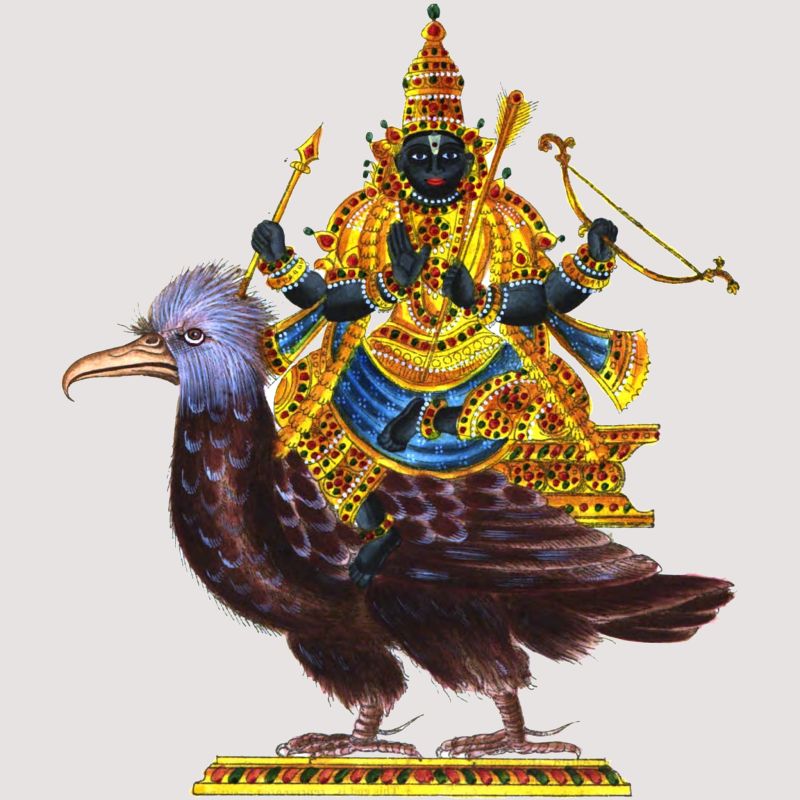
Image source: Wikipedia
In some accounts, Shani is depicted as lame or with a limp,
the result of a fight with his brother,
Yama, the god of death.footnote 6 This is an image that suggests trauma or injury —
factors intrinsic to the creation of any complex — and also conveys a connection to those ‘little deaths’
that happen in our lives, those wounds that live with us forever. Shani bears a connection to sorrow,
pain [and] ailments,
footnote 7 as well as to slavery,footnote 8
a powerful reminder that unhealed complexes are
enslaved to their trauma and can, in turn, enslave our egoic selves, as well.
Additionally, the story of Shani’s origin reveals profound connection to shadow:
Unable to bear the brightness of her husband, Sanjna, the wife of Surya, the Sun-god, left her husband’s house, took on the guise of a mare and spent her time grazing in the pastures away from the eyes of the world. Before doing so, she created her double, known as Chhaya or Savarna, from her own shadow to serve as the substitute-wife for the Sun in her absence … Shani was born to Chhaya, the shadow-wife of the Sun.
— K.S. Charak footnote 9
Interestingly, Chhaya — who is sometimes known as the goddess of shadows — resembles a complex, herself, a shadow version of a more egoic figure, Sanjna. And, in the way that our mothers remain a part of our psyches, Shani always carries this longstanding connection to shadow.
Shani is also associated with the element iron,footnote 10 which harkens back to images of gravity — a weightiness that resists change and that conveys a sense of the ‘iron will’ of complexes which insist on the reality of their understanding, even when it reinjures or retraumatizes them. At the same time, iron is fundamental to us; we carry it in our very blood.
Pyrite
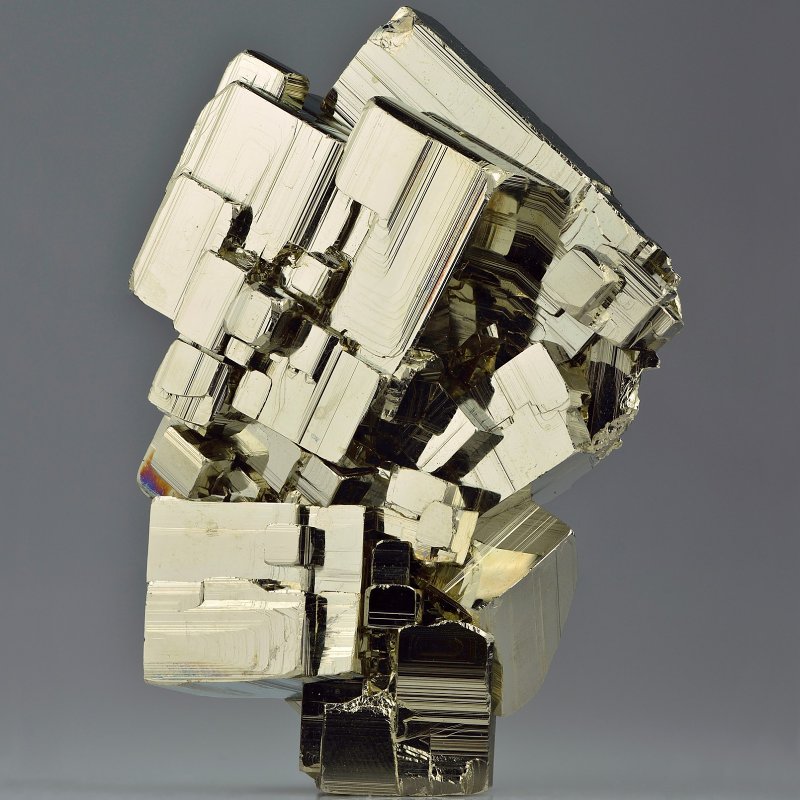
Image source: Wikipedia
Just as the iron in our blood is essential to us, and we would not be human without it, the Saturn/Shani archetypal images are good reminders that Saturnian stuckness, and difficulty with change, are part and parcel of our humanness. Put another way, our shadow and complexes are fundamental to us, and a piece of our path to wholeness.
Mercury / Hermes .
Rafael López-Pedraza opens the door to the role of Hermes footnote 11 in complex psychology:
— Rafael López-Pedraza footnote 12
Hermes’ borderline aspect favors his friendliness, or, to put it in more archetypal terms: he is the friendliest to the other gods … Hermes has no need to fight for his center; he does not have one. If we internalize Hermes’ friendly side, then it is Hermes in us who befriends our psychological complexes centered by other gods.
Here, López-Pedraza highlights the the notion that archetypes that sit at the heart of complexes — each, then, resembling a
small ’god’ within our psyche, with similar
imaginal powers, and modes related to the mythical figures they align with.
In this way, we might have complexes with Hera- and Zeus-type cores, the divine feminine and divine masculine,
each powerful in their own spheres, and exhibiting a syzygistic attraction between them, but also suffering a ‘jealous’
tension that creates strain in the psyche. Hermes, as friendly communicator, is able to stand outside such conflicts,
to act as a mediator, working toward greater accord. While Zeus and Hera may fight to hold the psychic center, Hermes
is always in motion, non-egoic, versatile and shimmering.
footnote 13 Jung makes special note of Mercury’s ability to befriend
all sorts: he runs round the earth and enjoys equally the company of the good and the wicked.
footnote 14 While it may not be
productive — or accurate — to think of any of our complexes as wholly good or truly wicked, Mercury’s
benevolent approach to both the bright and the shadowy, is well worth emulating.
Planetary Mercury
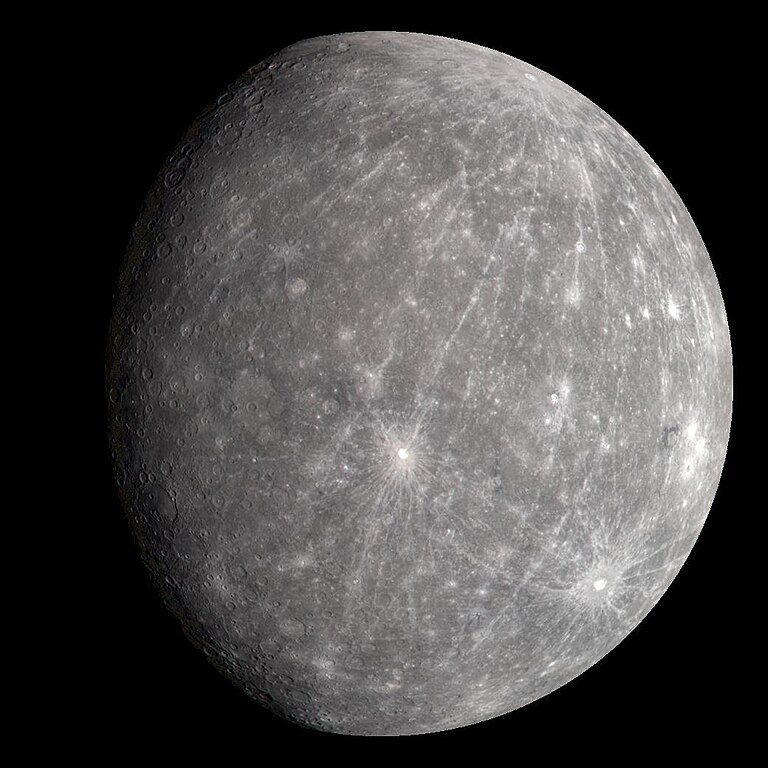
Image source: Wikipedia
Hermes’ non-authoritarian
footnote 15 viewpoint is powerful in complex work. too. If we ego-complexes can let go of
the idea that we must hold center stage, that we have no turf to guard, we can, in turn, act as a friend to inner
figures, striving to create a forum in which the voices of the internal pantheon are heard, balancing needs that
initially appear in conflict. There is a benign craftiness required to do this work, an imaginal diplomacy that
requires the fluidity of elemental mercury. These, too, are traits of Hermes.
Hermes, López-Pedraza adds, is what might be called the matrix of Jung’s psychology.
footnote 16 Recalling that it was
Jung who unpacked the idea of the complex and emphasized the importance of complexes in psyche, it makes sense that
the Hermes figure would resonate both with depth psychology and with complexes, generally. Dennis Harpur goes so far
as to call Hermes the patron of daimonic reality
footnote 17 — a territory roughly akin to the imaginal, and the
subtle territory where we meet and interact with our complexes.
Archetypal Mercury (Hermes)
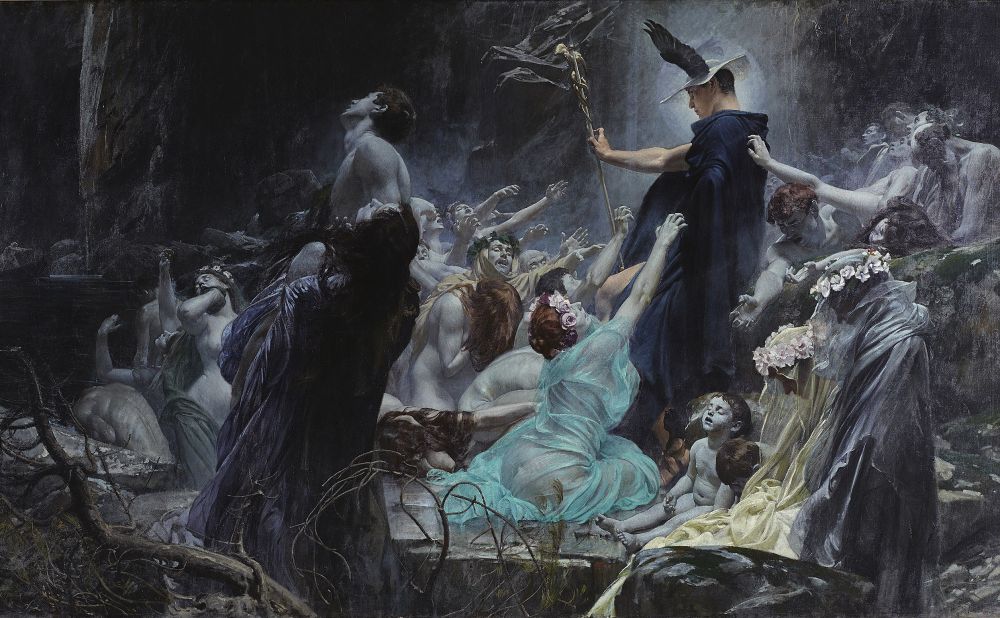
Image source: Wikipedia
Harpur also highlights the role of Hermes as psychopomp or guide of souls.
footnote 18 As the psyche of psychology
indicates soul, we might consider that a psychopomp would be precisely the archetypal image we need to help us
conduct traumatized complexes toward healing, to shift shadowed material into light, and to release the accumulated
burdens of psyche, as a whole. And, in fact, when we consider Jung’s assertion that Hermes is
the archetype of the unconscious
footnote 19
Mercury as patron of communication may be precisely the figure to help us find a shared language for interacting with our complexes.
— Marisa Swankfootnote 20
The mercurial acts as a mirror for the relation between the conscious and the unconscious.
One of Hermes’ unique capacities that can assist us in working with imaginal figures — figures who may be
dominated by powerful affects
and a tendency toward ‘tunnel vision’ — is the god’s ability to keep
one foot in and the other out.
footnote 21 This is essentially
the approach Johnson recommends in Inner Work:
to treat imaginal dialogues as if they are actually happening
and to participate with your feelings
footnote 22 —
but at the same time to bring an ethical, egoic light to to the sometimes overblown, seductive, dramatic urgings
footnote 23
of inner figures. By being deeply present with inner figures, but not being overwhelmed by them — the latter,
a situation Schwartz might call blending
footnote 24 — we are able to facilitate inner communication and help
complexes cross the boundaries that have prevented their growth.
Matangi .
The Tantric goddess Matangi is associated with the planet Mercuryfootnote 25 and shares a number of Hermes’ traits,
particularly those associated with communication and thought.footnote 26 Where Hermes serves as a messenger for the gods,
Matangi acts as the counselor to Rajarajeshvari … the Supreme Queen of the Universe.
footnote 27
In a sense, both are ‘professional’ communicators.
But while Matangi may share many of Hermes’ gifts for facilitating work with complexes, she also embodies
important qualities that are entirely her own. Matangi’s earthly father was from the lowest caste
footnote 28
and she is described as outcast and impure.
footnote 29 In the context of this article, I am invoking images of
metaphorical and intrapsychic outcasts and impurities only: the lowly or otherwise unwanted parts of our
selves. Dwelling in the shadow region of psyche as complexes do — their traits rejected by consciousness
as dangerous or otherwise undesirable — complexes certainly might be understood as the outcasts of psyche,
and therefore in strong resonance with the archetypal image of Matangi. Approaching these figures with a respect
for the numinous presence within them — their archetypal cores — is a respectful way to begin inner work.
Matangi’s relationship to impurity comes to the fore in two of her names, Uccista Matangi or Uccista Candalini, where uccista, in Sankrit, indicates leftover or otherwise polluted food.footnote 30 So strong is this connection that, in religious contexts, the goddess Matangi is pleased to receive offerings of partly consumed food.footnote 31 Here, however, I would like to consider that this aspect of the Matangi archetype emphasizes those tendencies of psyche to pollute or contaminate one another. Seldom is the egoic self ‘uncontaminated’ by the presence of some complex or other. We experience our inner parts most directly when they, as noted above, ‘blend’ with us. In those moments, in a sense, we see through their eyes. We are ‘polluted’ by them, and they, equally, are ’polluted’ by us. At the same time, complexes carry the ‘leftover’ residue of our traumas and wounds. The fact that a goddess-figure embraces such contamination and residua suggests that maybe, as psychic experiences go, such states are normal or even — as food offerings are — valuable. The point, then, may not be to avoid blending with our complexes, but to be mindful of this interflow, to observe it and, rather than be carried off by these moments, to speak into them, to bear witness to them.
Frawley observes that Matangi is that portion of Saraswati
— goddess of
learning, art and culture
— which is allied with the transforming energy of Kali.
footnote 32
In this vein — and orienting from an archetypal rather than religious point of view —
one might then consider Matangi as carrying the syncretic essence of a Hermes-Kali blending,
a Mercury shifted to its wildish, shadow elements, as when the child Hermes killed a turtle
to invent the world’s first lyre.
— Raphael López-Pedrazafootnote 33
We must stick to the Image!
Applying and experiencing archetypal wisdom
Understanding that Saturn/Shani, Mercury/Hermes and Matangi are archetypal images whose natures dovetail with complex psychology, how might we begin by bringing that wisdom into our inner work?
López-Pedraza notes that a symbol — and, I would argue, an archetypal image —
can be a net to catch and gather the psyche, but also…can halt the adventure of psychic movement,
of exploring one’s nature and life.
footnote 34 In this way, working with archetypes to enrich our work with
complexes can deepen our work profoundly — or we can mis-use them as fodder for egoistic, strictly
intellectual analysis, neglecting the vibrancy and fluidity of the inner world. With that caveat in mind,
let’s consider some starting points for bringing the essences of Saturn, Mercury and Matangi into psyche.
Depth psychologists underscore the centrality of the image in psyche, and the image is perhaps one of the best places to engage the imaginal wisdom of an archetype. To be clear: images need not be visual — music offers sound-based image, and stories can contain images transmitted in words. To explore images of Saturn, for instance, we can begin in many places.
First, we might approach pictorial images. Some of the impressive Hubble images of the planet Saturn, for example. And there are plenty of fascinating forms of Shani in Indian art, ranging from the figurative to the abstract. Turning to sound, audio recordings of Shani mantras are available online, as are astrological lectures on the Saturn archetype. We can even move into images of touch, handling a piece of iron, feeling its weight in the hand. By steeping in these images, the Saturn/Shani archetype can begin to teach us, in an imaginal sense, about its qualities and potentials.
Shani mantra
Video source: Vimeo
Planetary images of Mercury are also available, in addition to the numerous ancient Greek and Roman depictions of Hermes and Mercury. In Hindu thought, the god Budh, or Budha, is the personified form of Mercury,footnote 35 and his mantras, icons and related imagery are available online, as well. And though you would be unwise to hold elemental, liquid mercury in your hand, a mercury thermometer provides a safe way to engage mercury through the kinesthetic sense.
In addition her association with images of the planet closest to our sun, the many fascinating depictions of Matangi, multi-armed and often emerald-green, stir the imagination and the psyche. But one of the most remarkable images associated with the goddess is her yantra, a geometric representation of Matangi. Just as Jung emphasized the relationship of mandalas to wholeness, yantra functions similarly, an imaginal depiction of the unfolding of an archetypal essence at its most subtle levels.
Matangi Yantra
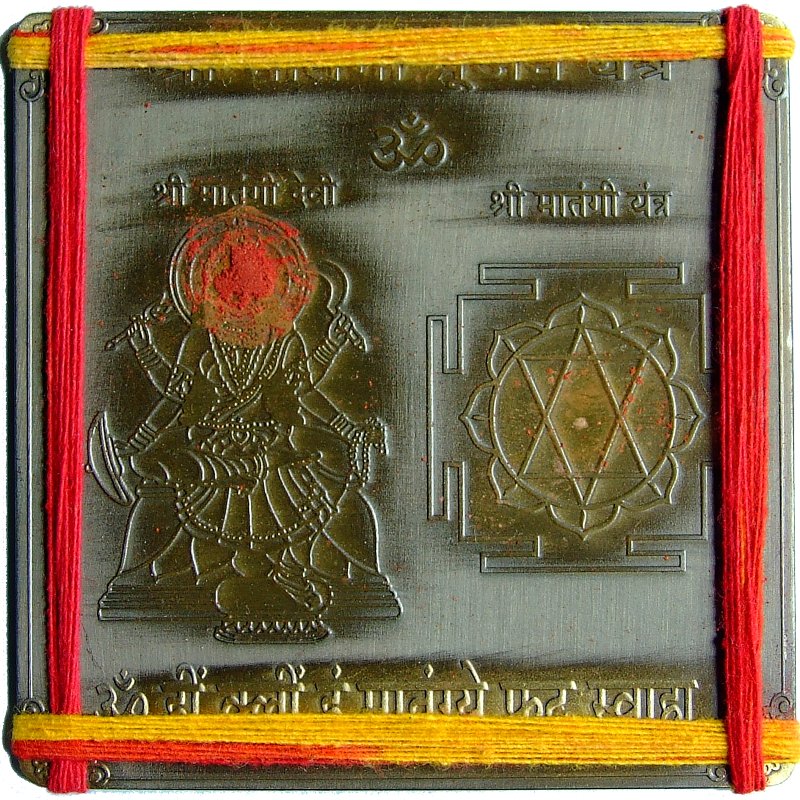
Image source: author’s own work
Matangi chants, mantras, and even pujas — rituals dedicated to the goddess — are available in video online. And, as a final imagistic suggestion, one might call to mind Matangi’s uccista nature while reheating food leftovers.
Besides the interactions we have with archetypal images in the outer world, we can also invite these same
forms into active imagination,
evoking and interacting with them, just as we might when we are working with
any inner image. As we do this, however, it is important to orient from a psychological, rather than a religious,
standpoint. We are looking at gods as psychic factors, that is, archetypes of the
unconscious.
footnote 36
As long as our interests are psychological rather than religious, our interactions in psyche should
generally be understood as representative of psyche.
Bearing this point in mind, however, we may discover that our imaginal (inner) Saturn or Matangi may have wisdom to offer, or even advice to improve our relationships with of our complexes. They may lead us more deeply into their imagery, or offer us stories that awaken our understanding and patience with our selves.
— C.G. Jungfootnote 37
Mercurius is closely related … to Saturn. As Mercurius he is juvenis, as Saturn, senex.
Archetypal kinship and beyond .
Given our discussion, Jung’s essay, The Spirit Mercurius
presents a pair of intriguing ideas: first,
that archetypal Saturn is, in a sense, the senex, or old man
aspect of Mercury,footnote 38 and second, that
the alchemical figure Mercurius (strongly related to Mercury/Hades) is Saturn’s Child.
footnote 39
Following such linkages, we can begin to form a sort of ‘venn diagram’ between our three archetypal, complex-related figures. Saturn and Mercury overlap at the senex point. Matangi and Hermes blend at their resonance both with planet Mercury and in their emphasis on the power of communication. Kali’s energy joined with Saraswati’s manifests in Matangi-nature, and Kali, in turn, is sometimes cited as Shani’s (Saturn’s) sister.footnote 40 Such blendings and kinships hint at an important principle; as the uccista nature of Matangi implies, there are few, if any, ‘pure’ archetypes, and archetypal images have numerous places of ‘contamination.’ What is fascinating is that these particular overlaps suggest we may be ‘constellating’ an appropriate grouping of images; Matangi, Saturn and Mercury may, indeed, have much to teach us about complex psychology. Additionally, such blendings suggest the image of complexes blending with the ego-complex, another sign that we are on the right metaphorical track.
While we might wish for a simple, easy-to-follow paths for working with our complexes, matters are, unsurprisingly, more complex. Inner presences — their origins, needs, and interactions — require a willingness to navigate a territory of shifting images that do not always speak in the vernacular of consciousness. Working with archetypal images can help us cultivate the skills of subtle communication, as well as fructifying our inner world with the riches of mythology and symbol. By spending time with the archetypal images of Matangi, Shani/Saturn, and Mercury/Hermes, we pursue an education that helps us harmonize with imaginal processes. We learn to speak and hear the languages of our selves, increasing our capacity to discern the speaking of ever deeper layers of the inner territories.